No-Op Update Pattern: State-Driven Idempotent Updates
After exploring idempotency keys, I came across another pattern that deserves more attention: the No-Op Update Pattern.
The idea is simple, but the mindset behind it is what makes it powerful.
Instead of treating every update request as something that must trigger work, you first ask a more important question:
Does this request actually change the state?
If the answer is no, the system should do nothing and return the current state.
That small shift changes how you think about idempotency.
The Core Idea #
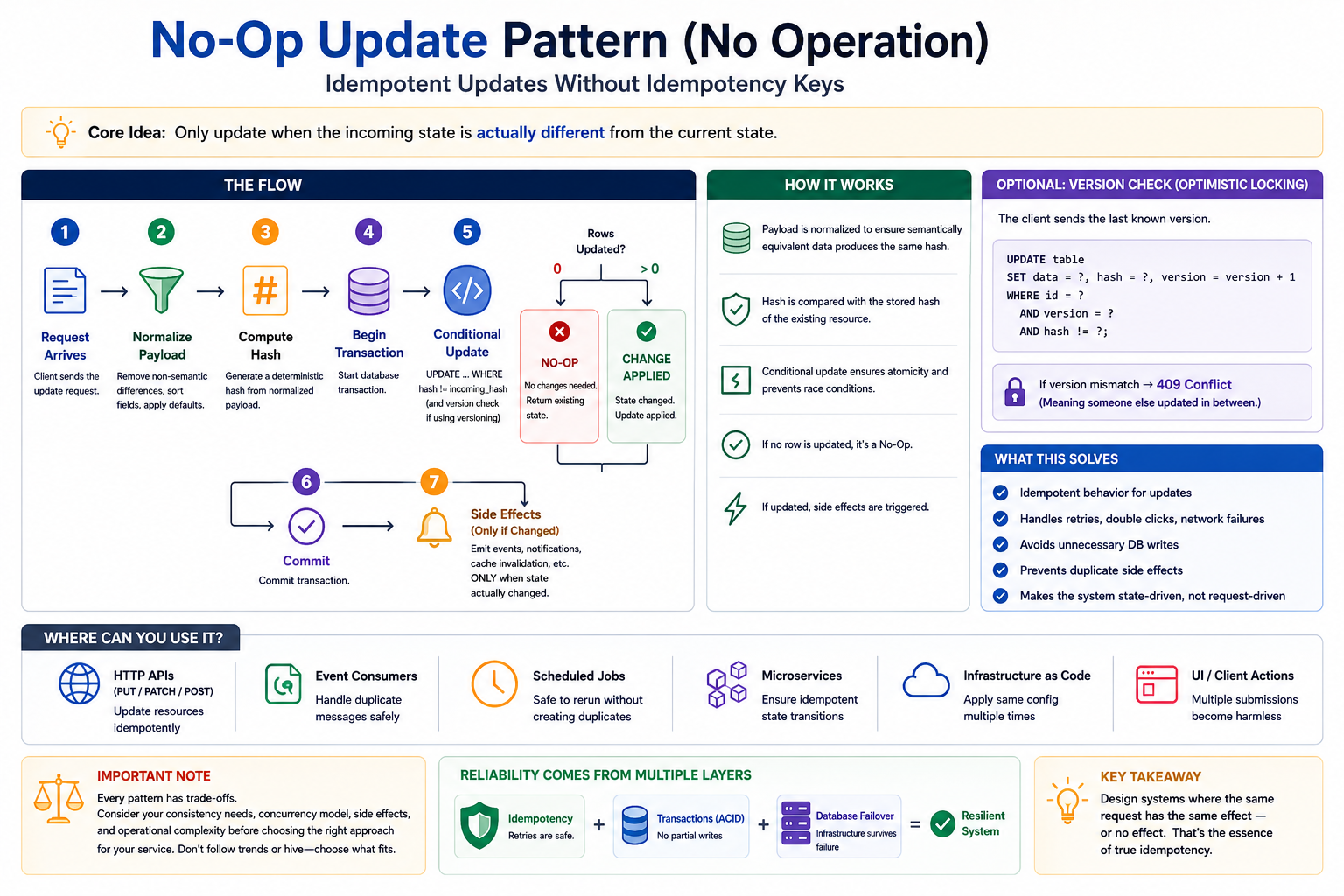
At a high level, the flow looks like this:
- Normalize the incoming request payload.
- Generate a deterministic hash from the normalized payload.
- Compare that hash with the stored hash for the current resource.
- If both hashes are equal, nothing changed, so return the existing state.
- Otherwise, apply the update.
The important rule is this:
Emit side effects only when the state actually changes.
That means no extra events, no duplicate notifications, no unnecessary downstream calls when the desired state is already the current state.
Why This Pattern Feels Clean #
What I like most about the No-Op Update Pattern is that it makes the system state-driven instead of request-driven.
That sounds subtle, but it changes the whole design philosophy.
In a request-driven model, every incoming call feels like something that must be processed. In a state-driven model, the request is just a declaration of desired state. The system compares that desired state with reality and decides whether work is actually needed.
Once you think this way, many operational headaches become much easier to reason about:
- retries
- double clicks
- duplicate requests
- network instability
- client timeouts
Why? Because repeated requests are no longer special. They simply reconcile toward the same desired state.
This is one reason the pattern shows up so often in declarative and reconciliation-heavy systems like Kubernetes and Terraform.
A Simple Example #
Imagine a profile update API.
The client sends:
{
  "full_name": "Vubon Roy",
  "email": "vubon@example.com",
  "marketing_opt_in": true
}Before updating the database, you normalize the payload so equivalent inputs always produce the same representation. For example:
- trim whitespace
- lowercase the email
- sort fields consistently
- remove values that should not affect state comparison
Then you hash the normalized result.
hash(normalized_payload) -> 4f8b2...Now compare that hash to the hash stored with the current profile row.
- If the hashes match, the request is a no-op.
- If the hashes differ, the state changed and the update should proceed.
That gives you a very predictable write path. In other words, the update should only proceed when the payload hash has changed and the caller is still working with the current version.
func UpdateProfile(req UpdateProfileRequest, expectedVersion int) (Profile, error) {
    normalized := Normalize(req)
    newHash := Hash(normalized)

    current := LoadProfile(req.UserID)

    if current.Version != expectedVersion {
        return Profile{}, ErrVersionConflict
    }

    if current.StateHash == newHash {
        return current, nil
    }

    updated := ApplyChanges(current, normalized)
    updated.StateHash = newHash
    updated.Version = current.Version + 1

    Save(updated)
    EmitProfileUpdatedEvent(updated)

    return updated, nil
}You can describe the rule as:
update only when hash != new_hash AND version == incoming_versionThat is the concurrency-safe gate that keeps the write path deterministic.
The key detail is that EmitProfileUpdatedEvent runs only when the state genuinely changes.
Add Versioning for Safer Concurrency #
An even stronger version of this pattern is combining it with versioning or optimistic locking.
The requester sends the version it last observed, and the update succeeds only if that version still matches the current record.
This protects you from silent overwrites when two clients try to update the same resource at nearly the same time.
So now you have two guardrails:
- State hash comparison tells you whether the request is a no-op.
- Version checking tells you whether the caller is operating on stale data.
That combination is clean, explicit, and usually much easier to reason about than building a larger idempotency-key workflow for every update endpoint.
Where This Pattern Works Well #
The No-Op Update Pattern is a strong fit when:
- clients repeatedly send full desired state
- updates are naturally modeled as resource replacement or reconciliation
- side effects should happen only on real change
- you want deterministic behavior under retries
It is especially useful for configuration APIs, settings management, control planes, admin dashboards, and systems that converge resources toward a desired state.
Trade-Offs Still Matter #
Like every pattern, this one is not universal best practice.
You still need to evaluate:
- your consistency requirements
- your concurrency model
- your side effects
- your operational complexity
For some systems, classic idempotency keys are still the right answer, especially when you need to deduplicate a request with a unique business intent rather than compare final state.
And if you need to improve latency or reduce database operations, then that becomes a separate design problem to solve. You might cache hashes, reduce read-before-write patterns, or restructure the update flow. The pattern does not remove those concerns. It just gives you a cleaner foundation for correctness.
Final Thought #
Engineering is not about following trends or hive mentality. It is about understanding the problem space deeply enough to choose the right trade-offs.
The No-Op Update Pattern is a good example of that. It is not magic. It is not always the best option. But when your system is really about reconciling state, this approach can be a very elegant alternative to leaning too hard on idempotency keys.
If your service accepts repeated update requests and the real question is “has the state changed?”, this pattern is worth keeping in your toolbox.