System Design Interview: Idempotency
Almost every candidate faces this question during a system design interview:
How do you handle duplicate transactions?
Most people answer: Idempotency key + Cache.
To be honest — that’s a good start.
But the real lesson comes when you build an actual payment system.
Duplicates are normal behavior #
In distributed systems, duplicates are not edge cases. They are normal behavior.
Duplicates can originate from anywhere:
- client double-clicks
- mobile retry on timeout
- API gateway retries
- reverse proxies
- silent network failures
- third-party timeouts
So the problem is not if duplicates happen.
The real requirement becomes:
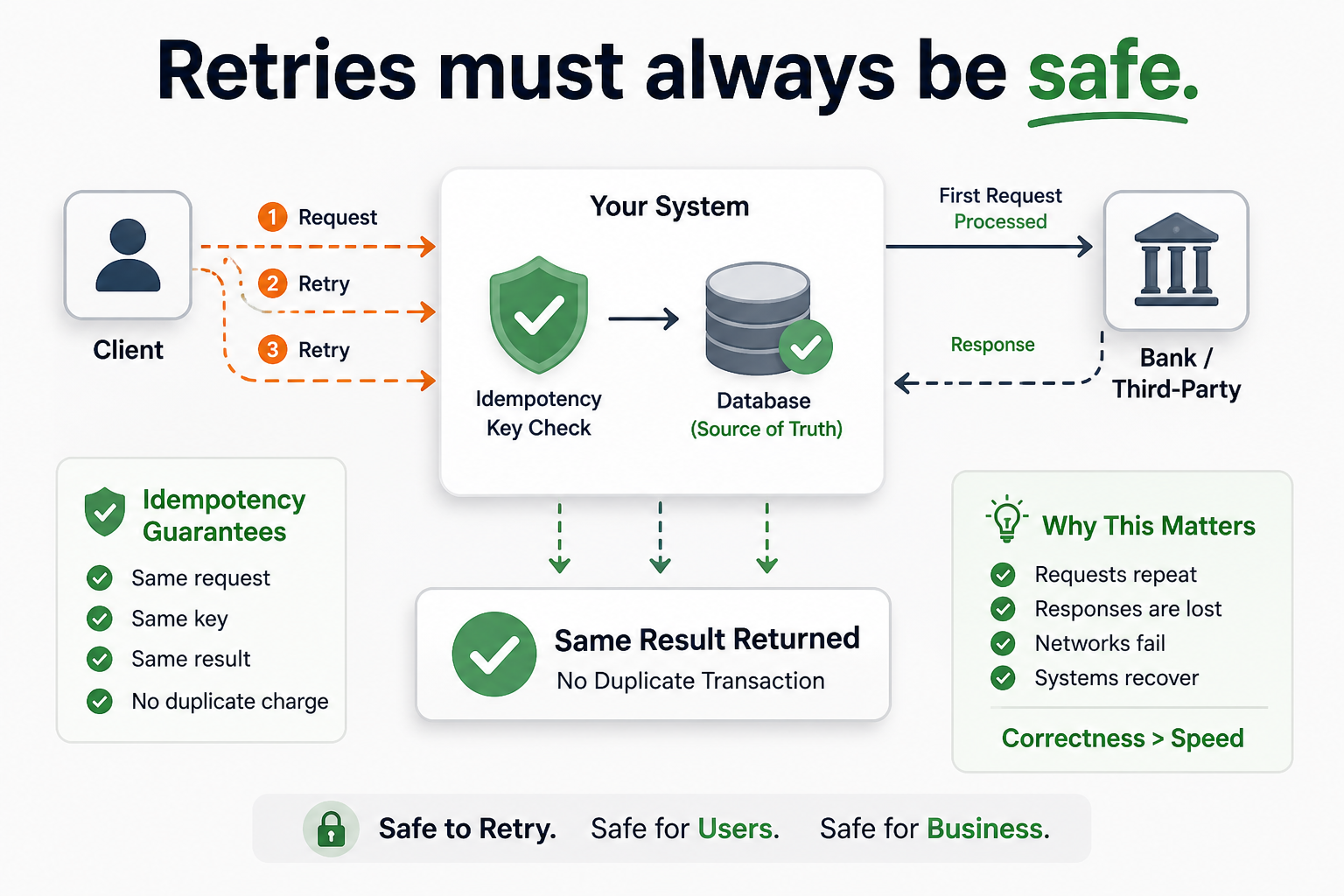
Retries must be safe without creating duplicate transactions. It shouldn’t matter where the retry happens.
What is idempotency? #
An operation is idempotent if performing it multiple times produces the same result as performing it once. Charge a customer once or ten times — idempotency means the outcome is always the same: one charge.
The approach that works #
Here’s what I’ve seen work well in production payment systems.
1. Redis as a performance optimization #
Redis is not the guarantee layer.
It’s only a fast lookup layer with temporary data. Think of it as a short-circuit — if the key is hot in cache, you skip the DB round-trip. But Redis alone is not enough.
2. Database = source of truth #
If the same request arrives again:
- don’t create a new transaction
- return the existing result
The database is the final source of truth. To handle concurrent retries safely, the insert must be atomic — if two identical requests arrive at the same time, only one should process and the other should return the stored result.
3. Persist before external calls #
Before calling the bank or any third-party service:
- persist the transfer record
- persist the ledger intent/state
Why? Because external systems are unpredictable. When failures happen, you still have a consistent state and can safely retry or recover.
If the bank call fails or times out, you have the record. You can retry safely — the idempotency key prevents a double charge on the next attempt.
Those three layers together — Redis, database, and persist-before-call — are what make a payment system actually safe to retry.
What a strong interview answer looks like #
When an interviewer asks this question, they want to hear three things:
You understand that retries are inevitable — not edge cases. Networks fail. Clients timeout. Gateways retry.
You know the layered approach — Redis for speed, database for durability. Not one or the other.
You persist state before calling external systems — so failures leave you in a recoverable, consistent state.
A complete answer might sound like:
“I’d have clients generate a UUID before making the request and send it as an
Idempotency-Keyheader. On the server, I check Redis first for a fast response. If it’s a miss, I check the database. If neither has it, I persist the intent to the DB before calling the external payment provider — so even if that call times out, I have a record and can recover. Once I get a result, I store it in both the DB and Redis. Any retry returns the same stored response.”
That answer covers the real problem (retries everywhere), the layered solution, and the persistence-before-external-call pattern — which is what separates a good answer from a great one.
Key takeaways #
- Duplicates in distributed systems are normal, not edge cases
- Redis is a performance layer, not a guarantee
- The database is the source of truth — always
- Persist intent before external calls — this is the part most people miss
- Idempotency isn’t a cache trick. It’s a system design mindset
In payments, correctness matters more than speed. Build systems that are safe to retry and many distributed problems suddenly become simpler.